
Assessing livestock is an important skill for any farmer. Understanding how those animals are classified, dressed and weighed after slaughter is just as important in protecting the return on the work that goes into producing them.
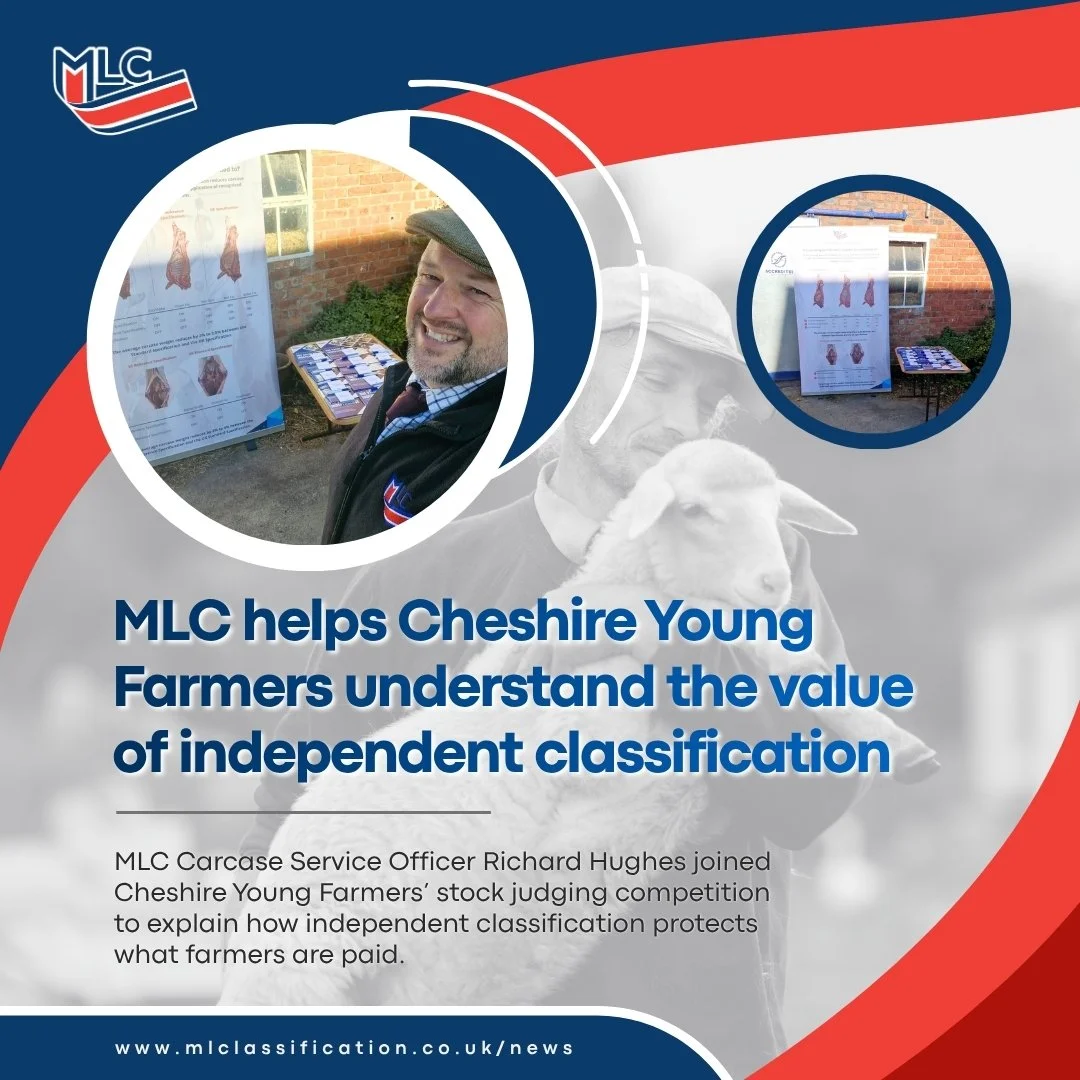
In October, MLC Carcase Service Officer Richard Hughes attended Cheshire Young Farmers’ beef and sheep stock judging competition, where he judged the junior fat lamb class.
Competitors were asked to place four butchers’ lambs in order and explain their decisions. Richard also delivered a masterclass, outlining what he was looking for and helping the juniors understand how to assess the animals and give clear reasons for their placings.
The event provided an opportunity to introduce the young farmers to MLC’s work and explain why independent classification matters to their businesses.
Why independence matters
When livestock are sold on a deadweight basis, carcase classification and payable weight directly influence the farmer’s return. An impartial assessment helps both farmer and processor have confidence in the transaction.
MLC provides independent classification alongside checks on carcase dressing and presentation. This oversight helps ensure that farmers’ livestock are assessed consistently and that departures from the required dressing specification are identified.
Dressing specifications affect the farmer’s payment
Dressing specifications define which parts of a carcase are removed or retained before weighing. Different specifications produce different carcase weights, so the price offered per kilogram should always be considered alongside the specification being used.
If a carcase is trimmed beyond the requirements of the declared specification, the farmer can lose payable weight. Even a small loss per animal can become a significant sum across a batch or a year’s production. Incorrect dressing can also affect the assessment of conformation.
For example, a loss of just 1kg of payable weight at an illustrative price of £6/kg would reduce the return by £6 per animal, or £600 across 100 animals.
Farmers should therefore understand the dressing specification used by their abattoir, check their classification and payment documents, and query any unexpected results. Where NDTS (Not Dressed to Specification) is recorded, it is important to ask what departure occurred and how it may have affected the carcase’s weight or assessment.
Supporting the next generation
Stock judging competitions help young farmers develop their eye for livestock and their ability to explain an assessment. Connecting these skills with an understanding of carcase classification and dressing specifications helps them make informed marketing decisions too.
MLC was pleased to support the competition and share practical knowledge with the next generation of livestock producers.
To find an abattoir using MLC’s independent services, visit our Abattoir Directory.